Money
Longji Rice Terraces Tickets: What Eighty Yuan Buys
The gate ticket is eighty yuan and it is a three-day pass across all four villages. The shuttle, the buggy, the cable car and the long-hair performance are each charged separately, and that is where the guesswork starts.
In this guide
- What does a Longji Rice Terraces ticket cost?
- What does the ticket actually cover?
- Every extra, and what each one costs
- Why do published prices disagree?
- Which tours include the ticket?
- Is the ticket good value?
- Who pays less, and what do you need to show?
- Where should you buy it?
- What does a whole day actually cost?
- What do people get wrong about the ticket?
- How do you compare two fares fairly?
- Who pays what, in a family?
- How do you actually use the three-day validity?
- What if you cannot go?
What does a Longji Rice Terraces ticket cost?
CNY 80 for an adult aged 18 to 59. CNY 40 for over-60s with ID and for students under 18 with a student card. Free from age 65, for children under 1.2 metres, and for serving military personnel.
That is the gate price, and it has been stable for years. Where you see CNY 95 or CNY 100 quoted, a booking platform has bundled the scenic-area shuttle into the figure rather than charging you more for the same entry.
What does the ticket actually cover?
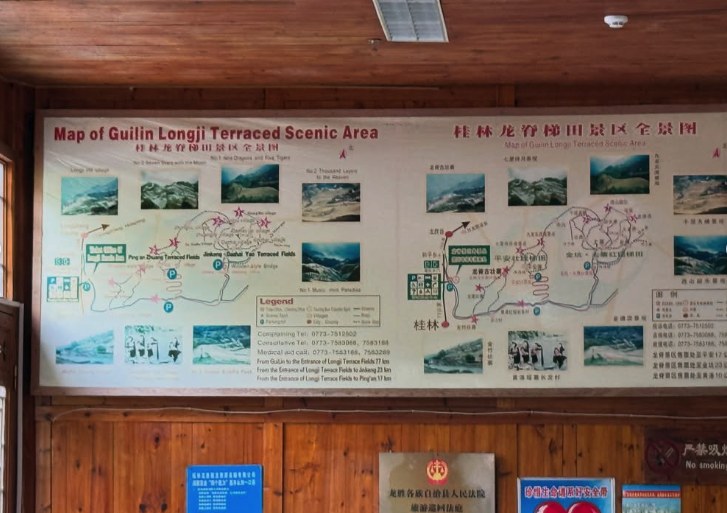
All four villages on one ticket: Ping’an, Jinkeng Dazhai, Guzhuang and Huangluo Yao Village. It is a through-ticket rather than a per-area one, so moving between valleys costs nothing extra.
It stays valid for three days from the date you booked it for. That is the most under-used fact about a Longji visit, because it makes a two-day trip — one valley, a guesthouse, the other valley — cost exactly the same in admission as a single afternoon.
Every extra, and what each one costs
| Extra | Cost | Compulsory? | Who absorbs it |
|---|---|---|---|
| Scenic-area shuttle | CNY 40 | Yes, for vehicles of 10+ seats | Absorbed by some fares |
| Electric buggy, Ping’an | CNY 30 one way, CNY 50 return | No — it replaces a 30-minute climb | Included one way on one fare |
| Dazhai ropeway | Paid at the station | No — the walk is 1 hr 30 | Return trip included on one fare |
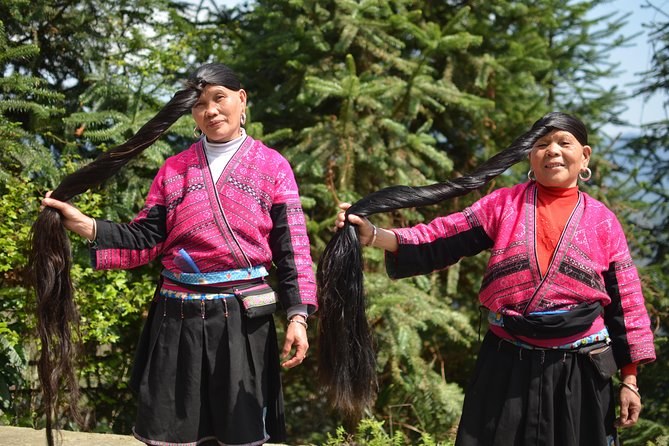
| Long-hair performance | about CNY 80 | No | Included on one fare |
| Village lunch | Paid locally | No | Included on several fares |
| Highway tolls | CNY 70 round trip | Only where a listing names it | Excluded on one tour |
| Gratuities | CNY 50–100 per person, suggested | No | Named as an exclusion on several |
Extras as each operator states them on its own listing. The ropeway fare is quoted inconsistently across published sources, so it is settled at the station.
Why do published prices disagree?
Three figures circulate: CNY 80, CNY 95 and CNY 100. They are not three prices for the same thing.
The Guilin municipal information service published CNY 80 in April 2026, with the half-price and free categories set out, and two operator listings independently name CNY 80 as the amount you pay at the gate when their fare excludes it. That is the admission.
The higher figures come from booking platforms selling a package: entry plus the shuttle, or a seasonal rate applied to a bundle. Neither is wrong as a price for what it sells. Neither is the gate price.
Which tours include the ticket?
Most of them, and the card for each one says so. The pattern is worth knowing before you compare prices: the cheapest fares are usually cheapest because the ticket is not in them.
Some fares exclude it outright and say so in yuan, which is the honest way to do it. Others include it on a fuller booking option and not on the basic one. The rest have it in the price.
Add CNY 80 to any excluded fare before you compare it with an included one, and the ranking changes for several of them.
Is the ticket good value?
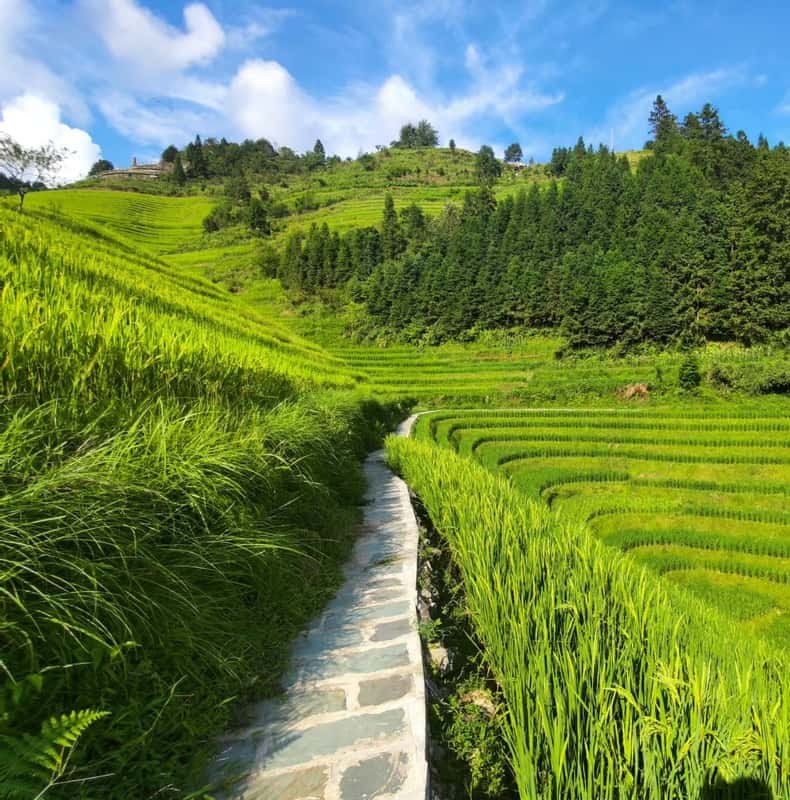
For eleven and a half square kilometres of terraced mountain with five viewing platforms, a three-day validity and four villages, it is difficult to argue otherwise. Comparable Chinese scenic areas charge considerably more for less ground.
The extras are where value gets debatable. The shuttle you often cannot avoid. The buggy is worth it if the climb is the problem and pointless if it is not. The ropeway is the one genuinely large discretionary spend, and it buys the widest view in the scenic area to somebody who could not otherwise reach it.
Who pays less, and what do you need to show?
- Age 60–64: half price, with ID.
- Students under 18: half price, with a student card.
- Age 65 and over: free.
- Children under 1.2 metres: free.
- Serving military: free.
Documents are checked at the gate, so bring your passport. Reduced tickets are bought at the window rather than online, which is one reason to carry cash even if your tour covers admission.
Where should you buy it?
At the entrance, if you are arriving independently. There is a ticket office, the queue is short outside holiday weeks, and it takes cash and mobile payment.
Through your tour, if the fare includes it. That is genuinely the easiest version: you go through the gate with the group and never see a window.
Online in advance is possible through the scenic area’s own mini-programme, but it is designed for domestic visitors and is awkward without a Chinese payment method. It saves no money and very little time.
What does a whole day actually cost?
Independently: bus fares of CNY 100 to 120 return, CNY 80 for the ticket, CNY 40 for the shuttle, lunch, and the buggy if you want one. Somewhere around the equivalent of $40 to $50 with everything.
On a fixed departure: $65 to $160 with the ticket and the guiding in it, and lunch included on some. On a private car: $68 to $193, with two of those priced per vehicle rather than per head.
The honest summary is that the admission is a small part of the day’s cost. What you are really buying is the two-and-a-half-hour drive, twice.
What do people get wrong about the ticket?
Three things. They budget CNY 100 because a booking site said so, and are then surprised by the shuttle on top. They assume their tour fare includes admission when it does not. And they throw the ticket away on the first evening, not knowing it lasts three days.
All three are avoidable at the booking stage. Check the exclusions list on your tour, carry the CNY 80 in cash whether or not you expect to need it, and keep the ticket.
How do you compare two fares fairly?
Add the exclusions before you compare the headline. A fare that excludes the CNY 80 ticket is CNY 80 more expensive than it looks, and one that excludes lunch is another modest sum on top. Once both are added, several of the rankings on price change places.
Then compare the hours on the hill rather than the total length of the day, because a pair of tours running the same total hours can differ by three hours at the terraces. That figure is listed for every option on Longji Rice Terraces ticket prices and tours, and the fuller breakdown of what a ticket buys is on the visiting page.
Finally, check the valley. Two fares at the same price are not comparable if one goes to Ping’an and the other to Jinkeng Dazhai, and the mapping is on the four villages page.
Who pays what, in a family?
A family of two adults and two children under twelve pays two adult tickets and, depending on the children’s height, either nothing or nothing again — under 1.2 metres is free, and there is no separate child band above that until the student category at school age with a card.
Where the money actually goes with children is the buggy at Ping’an or the ropeway at Dazhai, because both replace a climb that small legs will refuse. Budget for one of the two rather than treating it as optional.
Grandparents do well here: half price from 60 with ID and free from 65, which is more generous than most Chinese scenic areas.
How do you actually use the three-day validity?
Keep the ticket. That sounds obvious and it is the most common thing people get wrong, because a day-trip mindset says the ticket is spent when you leave.
The shape it enables is Ping’an in the afternoon of day one, a guesthouse in the village overnight, and Jinkeng Dazhai the following morning. Two valleys, the terraces lit after dark, and the cloud at first light — for one admission rather than two.
It also covers the weather. If day one is fogged in, you have not lost the ticket, and a second attempt costs you nothing but a bed. That is worth more here than at most attractions, because the cloud decides so much of what you see.
What if you cannot go?
Every tour here can be cancelled by you in full up to 24 hours before it starts. That is the useful protection, because it covers the weather, which is the thing most likely to change your mind on a mountain.
The gate ticket itself is bought on the day, so there is nothing to refund if you never go. Which is another argument for a fare that includes it: fewer moving parts.
Questions this guide gets asked
How much is a Longji Rice Terraces ticket in 2026?
CNY 80 for an adult, CNY 40 at 60 to 64 and for students under 18, and free from 65 or under 1.2 metres. It is a through-ticket for all four villages and stays valid three days.
Why do some sites say CNY 100?
Because they are selling a bundle that includes the scenic-area shuttle, or applying a seasonal package rate. The admission charged at the gate is CNY 80.
Is the shuttle bus compulsory?
Only if your vehicle carries ten seats or more, because large coaches are not allowed up the village roads. It is CNY 40 per person, and some fares here absorb it.
Can I use the ticket on more than one day?
Yes, for three days from the date you booked it for. It is what makes a two-day trip — one valley each — cost the same in admission as an afternoon.
Do I need cash?
Yes. The ticket window, the buggy, the village restaurants and the stalls all run on cash or Chinese mobile payment, and foreign cards are rarely accepted past the gate.
Every fare is listed with what it covers on Longji Rice Terraces tickets and tours.
Tours that fit this trip
Three fares that already cover the gate ticket, so the only thing left to pay for is lunch.