
The terraces
The Longji Rice Terraces
Eleven hundred hectares of paddy cut into a mountain ridge in northern Guangxi, farmed continuously by Zhuang and Yao families since the Yuan dynasty, and still a working farm rather than a monument.
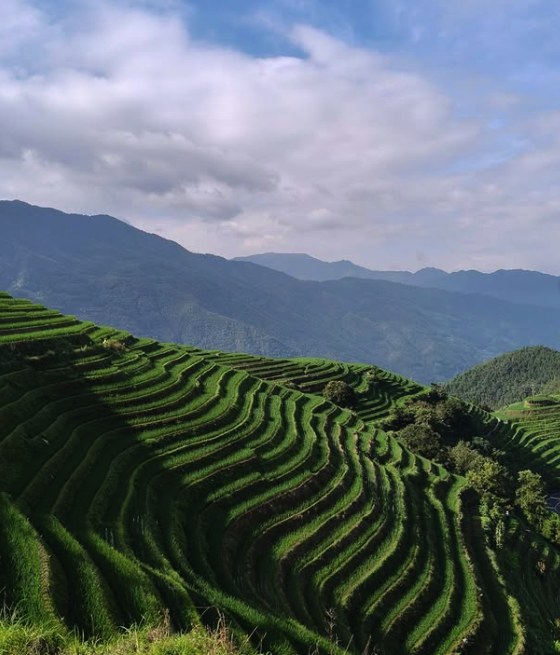
A ridge shaped like a dragon’s spine
Longji means dragon’s backbone. The name describes a shape rather than a legend. The main ridge runs roughly north to south, with subsidiary spurs falling away from it. From the platforms the terraced contours read as vertebrae along a spine.
The terraces are cut into those spurs, from the valley floor almost to the tree line. The paddies follow the contour rather than the fall line. So a single field can curve through most of a semicircle, and the water in it stays level all the way round.
Two names appear alongside Longji on maps and in tour listings. Longsheng is the county, and Dragon’s Backbone is the usual English rendering. All three point at the same place.
1,174 hectares between 300 and 1,100 metres
| Terraced ground | 1,174 hectares |
| Scenic area | about 66 square kilometres |
| Altitude | 300 to 1,100 metres |
| Slope | mostly 26–35°, reaching 50° at the steepest |
| Villages inside the ticket | Ping’an Village, Jinkeng Dazhai, Guzhuang (the Ancient Zhuang Village) and Huangluo Yao Village |
| Heritage status | FAO Globally Important Agricultural Heritage System, 5 February 2018 |
Figures from the FAO Globally Important Agricultural Heritage record and the Chinese Ministry of Agriculture citation of February 2018.
The altitude range is the number that shapes a visit. A thousand-metre spread means the same hillside floods, greens and ripens over several weeks rather than on a date. In late September the top of a slope can be cut while the bottom is still yellow.
Two answers to “how old”, and both are true
The published figures disagree by seventeen centuries. The disagreement is not an error. Chinese tourism sources give 650 years: begun under the Yuan dynasty, which ran from 1271 to 1368, and finished in the early Qing. That is the age of the paddies photographed today.
The Ministry of Agriculture’s heritage citation says more than 2,300 years, which is the age of terraced rice farming in these mountains rather than of the present fields. Both are correct; they measure different things. Most guides pick one and are half right.
The Zhuang and the Yao who cut them
Longsheng is an autonomous county of several minorities: Zhuang, Yao, Miao, Dong and Han. The terraces were built by the first two. Zhuang families hold the ground around Ping’an Village and the ancient village at Guzhuang. Yao families, the branch known locally as Red Yao, hold Jinkeng Dazhai and Huangluo Yao Village at the foot of the road.
The division matters on the ground. Architecture, dress and food differ between the two valleys, and a day that visits only one sees only half of it. Both are inside the same ticket.
Agricultural heritage, not World Heritage
On 5 February 2018 the FAO designated the Guangxi Longsheng Longji Terrace System a Globally Important Agricultural Heritage System. The listing also covers terraces in Jiangxi, Hunan and Fujian. The designation recognises a farming system still in use, which is a different thing from a monument.
Longji is not a UNESCO World Heritage Site. The claim appears often enough in tour blurbs to be worth correcting. The UNESCO-inscribed Chinese rice terraces are the Honghe Hani terraces in Yunnan, six hundred kilometres away and a very different trip. The two are set against each other in the Longji and Yuanyang comparison.
Ping’an and Jinkeng: one ticket, two landscapes
The scenic area holds two main terrace bowls and they are not interchangeable. Ping’an sits 17 kilometres past the entrance. It is the compact and photogenic one: a village on a shoulder, two numbered platforms above it, and a climb of twenty to thirty minutes to reach them.
Jinkeng Dazhai sits 23 kilometres in, higher and considerably larger, with three viewpoints and a ropeway that removes the climb. It takes longer to reach and rewards a longer stay.
Most day tours choose one for you without saying so plainly. That is why the choice is worth making first. The Ping’an and Dazhai comparison sets them side by side, and the villages themselves are covered on the four villages page.
Decide which valley first, then the tour
Ping’an and Jinkeng Dazhai make two different days out of one ticket. Every tour is listed by which of them it goes to and how long it stays there.
Still a working farm
Rice is planted, flooded, grown and cut here on an agricultural calendar, not a visitor one. That is why water levels differ between adjacent paddies. It is why some fields are cut in September and their neighbours in October, and why parts of a slope are sometimes bare.
It also sets the etiquette. The paths are field bunds and the stone stairways between them are the villagers’ route to work. Standing in a paddy for a photograph is standing in somebody’s crop.
The other consequence is seasonal, and it is the one worth planning around. What the hillside looks like changes completely four times a year. The difference is set out month by month on the best time to visit.
The names you will see on a map
Tour listings and road signs use several names for the same ground. That makes searching harder than it needs to be. Longji Rice Terraces and Longsheng Rice Terraces are the same scenic area, and Dragon’s Backbone is the English translation of the first.
Jinkeng and Dazhai are used almost interchangeably for the northern bowl. Jinkeng is the terrace area; Dazhai is the village inside it. Ping’an is both a village and the terrace area around it. Guzhuang is sometimes rendered as the Ancient Zhuang Village.
Everything bookable at any of them is listed together on Longji Rice Terraces Tours.