Getting in
Visiting the Longji Rice Terraces Independently
Buses leave Guilin from half past six in the morning and the gate ticket is eighty yuan, so nobody needs a tour to stand on the ridge. What a tour buys is the twenty-three kilometres past the gate, and somebody who knows which path is which.
In this guide
- Can you visit the Longji Rice Terraces without a tour?
- How do you get there on public transport?
- What does it cost each way?
- The arithmetic, done honestly
- What do you actually give up going independently?
- Is there a middle option?
- How would you plan the day yourself?
- Is it easier if you stay the night?
- Who should book a tour anyway?
- Who should not?
- What should you actually do with the day?
- Does going independently work in every season?
- What time should you leave, and when must you turn round?
- The honest verdict
Can you visit the Longji Rice Terraces without a tour?
Yes, comfortably, and for a lot of people it is the better answer. Buses run from Guilin through the day, the gate ticket is CNY 80, and the villages are full of restaurants and guesthouses. Nothing about the scenic area requires a guide.
What a tour buys is not access. It is the 17 or 23 kilometres between the entrance and the village, somebody who knows which path goes where, and a fixed time to be back in Guilin. Whether that is worth the money depends on how you like to travel.
How do you get there on public transport?
Buses leave Guilin from Qintan Bus Station at 31 Cuizhu Road in Xiangshan District. The first is at about 06:25 and the last at around 18:10, roughly every twenty to forty minutes through the middle of the day. The run takes about an hour and a half.
Fares are quoted between CNY 50 and CNY 60 depending on the service, and some buses go to the Longji junction rather than the gate, where you transfer. Ask at the window which yours does before you buy the ticket.
From the entrance you still need transport up to the village. That is the scenic-area shuttle, and it is the part independent visitors most often forget to budget for.
What does it cost each way?
| Bus and gate ticket | Private car | Join-in day tour | |
|---|---|---|---|
| Transport | CNY 50–60 each way | From $78 per person, or $136 per car | Included |
| Gate ticket | CNY 80, you buy it | In the fare on six of nine | In the fare on most |
| Up to the village | Shuttle, CNY 40 | The car drives you | Included |
| Guide | None | On six of nine | Always |
| Lunch | You choose and pay | On three of nine | On some |
| Time cost | A whole day, loosely | 8–10 hours | 8–10.5 hours |
| Flexibility | Total | High | None |
Bus fares vary by operator and by whether the service runs to the gate or the junction. Tour fares are the published starting prices, August 2026.
See what the guided days include
The arithmetic, done honestly
Independently, a day costs roughly CNY 100 to 120 in bus fares, CNY 80 for the ticket, CNY 40 for the shuttle and whatever you eat. Call it the equivalent of $35 to $45 with lunch.
The cheapest join-in day tour is $65 with a licensed guide and hotel pickup, and the cheapest private car with a guide is $68. So the gap is roughly $25 to $30 a head, and what it buys is the door-to-door transport, the guiding and the certainty.
For one traveller that gap is real money. For two it is the price of a good lunch. For four in a per-car fare, the tour is cheaper than the buses.
What do you actually give up going independently?
Three things, and only one of them is important. You lose the guiding, which matters more here than at most attractions because the villages are the interesting part and nothing is labelled. You lose the door-to-door transport. And you lose the fixed return, which on a mountain road in the afternoon is worth something.
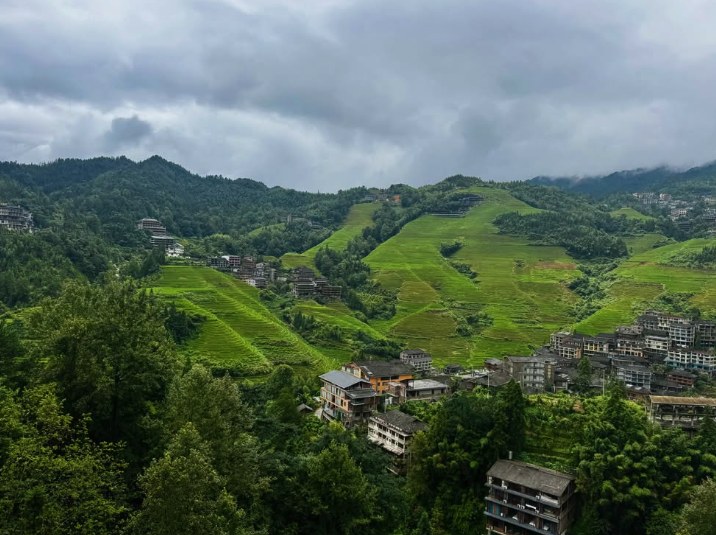
You do not lose access, comfort or safety. The paths are stone steps, the villages have restaurants and toilets, and the scenic area is open all day.
Is there a middle option?
There is, and it is the one most people miss. Three fares here are a private car and driver with no guide and no ticket — the road handled, the day yours. Two are priced per vehicle rather than per head, so a group of four splits one figure.
That is the independent trip with the two-and-a-half-hour drive taken off your hands. You buy the ticket at the gate, choose your own valley, walk what you want and go home when you are ready.
How would you plan the day yourself?
- Leave Guilin by seven. The early bus gets you to the gate before the coaches.
- Buy the ticket at the entrance. Cash, and keep it — it is valid three days.
- Take the shuttle up. To Ping’an if it is your first visit, Dazhai if you want the bigger bowl.
- Climb before it gets hot. Twenty to thirty minutes at Ping’an, or the ropeway at Dazhai.
- Eat in the village. Bamboo rice, cash, somewhere between the platforms.
- Start back by four. Work backwards from the last bus rather than forwards from the viewpoint.
Is it easier if you stay the night?
Considerably, and it turns the weakest thing about an independent visit into the strongest. You lose the return-journey anxiety entirely, you get the terraces lit after dark, and you are in position for the cloud at first light.
The one complication is luggage. Vehicles are restricted on the village roads and the paths are stone stairways, so travel light and expect to carry your bag the last stretch. Two operators recommend sleeping in Guilin the night before a day trip for exactly this reason.
Who should book a tour anyway?
Anyone on a tight schedule, because the buses are frequent but the day is long and the margins are thin. Anyone travelling with small children, because the road is the hard part and a private car can stop. And anyone who wants the villages explained rather than looked at.
Anyone in a group of four or more should at least price the per-car fares before buying bus tickets, because the arithmetic often flips.
Who should not?
Confident independent travellers with a spare day and no fixed plans. If you are happy buying a bus ticket in a station where the signage is Chinese, and you would rather choose your own lunch and your own turning point, a tour is buying you something you do not want.
Photographers staying overnight are the other clear case. No day tour can put you on a platform at sunrise, so the tour adds cost without adding what you came for.
What should you actually do with the day?
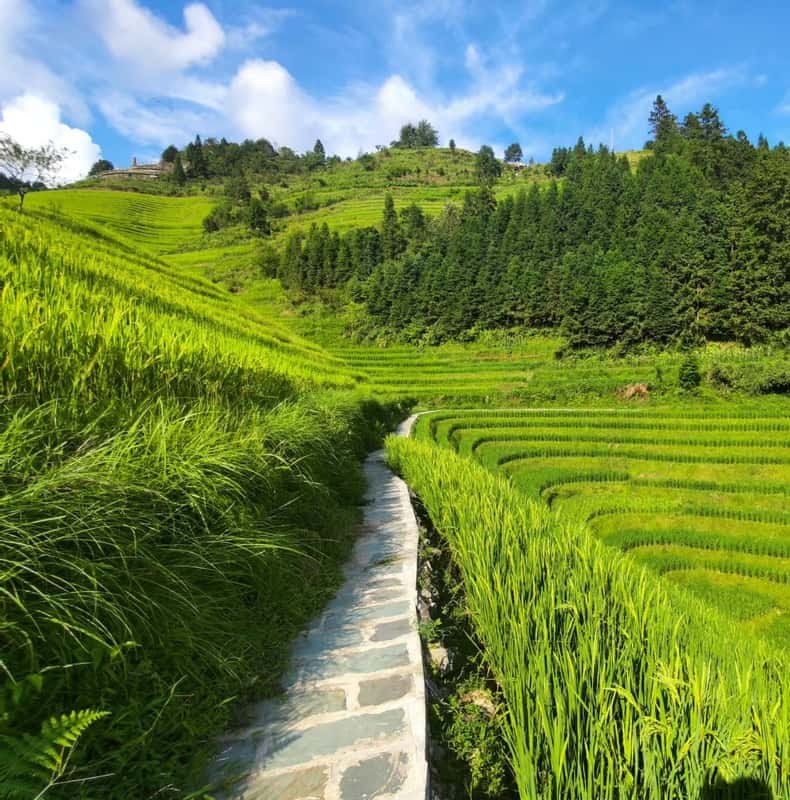
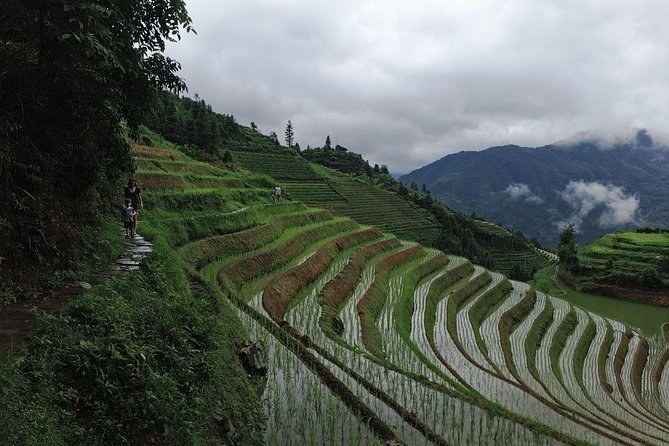
Pick one valley and walk it properly rather than trying to see both. Ping’an is the shorter climb and the more famous view; Jinkeng Dazhai is bigger, quieter and has a ropeway that removes the ascent. The two are compared in detail on the Ping’an and Dazhai guide.
Whichever you choose, allow four hours on the hill. That covers the climb, both of the numbered platforms and a village lunch without watching the clock. Under two hours you are looking at the terraces rather than walking them.
The five platforms, the walks between them and what each one gives you are set out on things to do at the terraces.
Does going independently work in every season?
Better in some than others, and daylight is the reason. From November to February the light goes early, the last bus back is the binding constraint, and an independent day trip gets tight. Those are the months to stay overnight if you can.
Through the harvest weeks in late September and October the buses are busy and the guesthouses fill, so book a bed before you commit to the plan. The rest of the year an independent day is straightforward.
What the terraces look like in each month is on the best time to visit.
What time should you leave, and when must you turn round?
Take the earliest bus you can face. The 06:25 from Qintan puts you at the junction before eight and on the hill by nine, which is two hours ahead of every coach and inside the last of the morning cloud. It is the single biggest advantage independent travel gives you here.
Turning round is the harder discipline. Work backwards from the last service rather than forwards from the viewpoint: allow half an hour down from the platform, twenty minutes for the shuttle to the gate, and a margin for a bus that is full. In practice that means starting your descent by four.
If that feels tight, it is, and it is the strongest argument for either a private car or a night in a guesthouse. Both remove the clock from the day entirely.
The honest verdict
Solo and flexible: go independently, and spend the difference on a guesthouse. In a pair: it is close, and the guiding usually wins it. Four or more: take the per-car fare, because it is cheaper than the buses and better in every other way.
Whichever you pick, the gate ticket is the same CNY 80, the ticket lasts three days, and the terraces do not care how you arrived.
Questions this guide gets asked
Do I need a guide to enter the Longji Rice Terraces?
No. It is a public scenic area with a ticket office, and nothing inside requires a guide. The CNY 80 ticket is sold at the entrance to anybody who turns up.
Where do buses to Longji leave Guilin from?
Qintan Bus Station, at 31 Cuizhu Road in Xiangshan District. Services run from about 06:25 to 18:10, roughly every twenty to forty minutes through the middle of the day.
How much is the bus?
Between CNY 50 and CNY 60 each way depending on the service and whether it runs to the gate or to the Longji junction. Confirm at the window rather than relying on a figure online.
Can I get a taxi from Guilin?
You can, and it is effectively the same as booking a private car except that you negotiate it yourself and the driver has no reason to wait. The private transfer fares here start at $78 per person and $136 per car.
Is it safe to walk the terraces alone?
Yes. The paths are stone steps between working fields, the villages are inhabited, and there is phone signal along the main routes. Download an offline map if you plan to cross between valleys.
If the arithmetic points the other way, every guided option is on Longji Rice Terraces Tours.
Tours that fit this trip
The middle option: a car and a driver, with the walking, the ticket and the day left to you.

Longji Rice Terraces Private Car & English-Speaking Driver
From $136 per group (up to 8)
Check Availability